itf.fi
Suomeksi

Sasaja

An accessible ITF Taekwon-Do club in Kalasatama, Helsinki. We offer a safe hobby environment also for children and young people who use communication methods that support or replace speech.

Register (MyClub) Club shop Theory guide

At a glance

Club
Sasaja Taekwon-Do, an accessible ITF Taekwon-Do club in Kalasatama, Helsinki (Kamppailukorporaatio)
Training sessions, spring 2027
Saturdays at Kalasataman koulu (Kalasatama school), 18:00–18:45
Programs
Leisure Program, Junior Black Belt, Senior Black Belt and Competitor (itf.fi/programs-en)
Languages of instruction
Finnish, English and sign support. An interpreter can be arranged for training sessions.
Price
Leisure Program €200 per year per child, and an adult accompanying the child trains free of charge. Licence €38 per year.
Registration
besa.myclub.fi, two free trial sessions
Contact
[email protected]

Club

Our club’s mission is to create a safe hobby environ…

Our club’s mission is to create a safe hobby environment that gives children and young people who use different communication methods that support or replace speech the chance to experience the meaning of their own hobby, as well as experiences of success and the joy of movement. This includes suitable conditions, skilled instruction, support services and cooperation with other clubs and federations in Finland.

Our values:
We care, we respect, we are brave

Sasaja’s vision is to offer varied hobby activities for children and young people who use different communication methods, and later to expand, for example, into music and the arts.

At first we will operate mainly in the Kalasatama area of Helsinki, in facilities allocated by the shift schedule. We train in City of Helsinki facilities. We have also trained occasionally at the Valimotie gym.

Flexibility is one of our core values and guides our activities both internally and externally. It means our ability to adapt to different situations, respond to the diverse needs of our members and work
smoothly with our partners. Flexibility is reflected in openness, accessibility and a sense of community.

To get started with training, get in touch by registering in MyClub

Our goal is that everyone can feel heard and find their place in our community.
Our added value is a constant desire to develop and grow – together!

About the sport

Belt system: The belt ranks are divided into ten colou…

Belt system:

The belt ranks are divided into ten colour belts, of which the white belt, 10th gup, is the first, the colour used on the beginners’ course, and 1st gup, red with a black stripe, is the last before the black dan ranks. There are nine degrees of black belt, marked with the Roman numerals I, II, …, IX dan.

I-III dan are assistant instructor ranks (Boosabeom), IV-VI dan are instructor ranks (Sabeom), VII-VIII dan are master ranks (Sahying) and the highest rank in the sport is IX dan, grand master (Saseung).

Disciplines and competition disciplines:

Fundamental movements:

Fundamental movements include a variety of hand and foot techniques practised for attacks and defences. The main way of training is traditional movement in formation, respecting military traditions. The curriculum of the sport also includes practising fundamental movements in four directions.

Patterns:

Patterns are formed from fundamental movements against imaginary opponents. In patterns, the fundamental movements are performed in a predetermined order, and they show the power and beauty of the sport in a formal package. Pattern competition is a very popular form of competition.
More about patterns
in the podcast of Suomen ITF Taekwon-Do ry (Finnish ITF Taekwon-Do Association).

Sparring:

Sparring training starts with three-, two- and one-step sparring, and progresses naturally through semi-free sparring and other variations to actual sparring. Sparring in ITF Taekwon-Do follows semi-contact rules, so skill and spectacle are emphasised over force. Sparring is one of the five main competition forms.

Special technique:

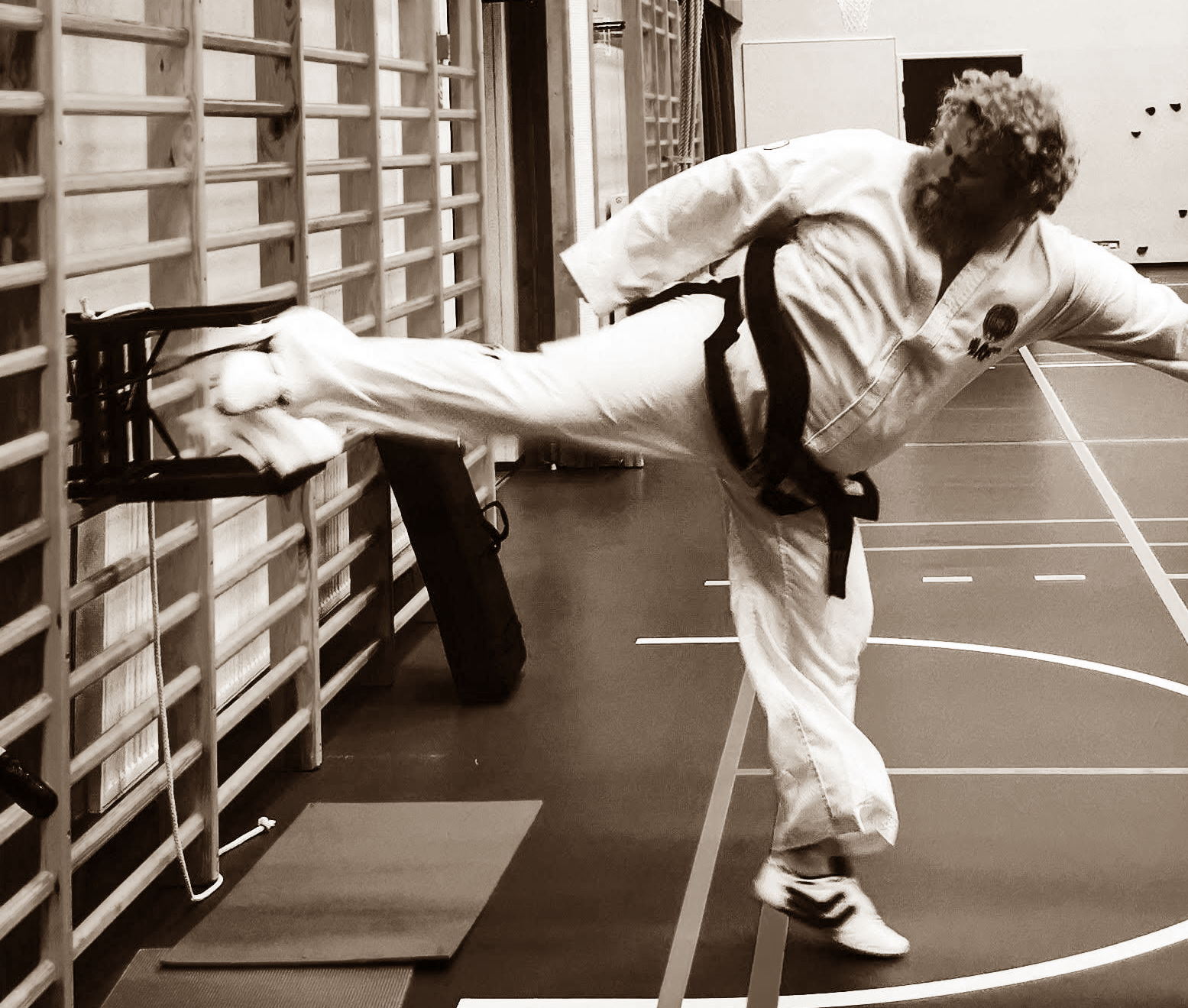
In special technique, the aim is to break boards with various jumping kicks from a considerable height. This discipline measures physical qualities excellently and is therefore one of the most spectacular competition disciplines.

Power breaking:

Whereas sparring aims to demonstrate technical skill with semi-contact, power breaking aims to show the real power of a technique by breaking thick wooden and plastic boards. Power breaking is also a competitive discipline, but only adults are allowed to take part.

Self-defence:

A self-defence demonstration is also a form of competition, but practical self-defence skills develop as a result of training in the sport. Self-defence is practised not only through the disciplines above, but also through various applications specific to each instructor.

Team events:

In addition to individual categories, Taekwon-Do also has team events in patterns, sparring, special technique and power breaking.

In the team pattern event, the team performs a predetermined pattern in a pre-rehearsed way in a pre-selected formation. In team sparring, the team members fight members of the opposing team, each in turn. Because there are no weight categories, the opponents can be of very different sizes.

In the team categories of special technique and power breaking, each team member performs one technique in their own turn.

Photo Michael Holler (2016 European Championships team sparring)

More information about the competition disciplines

More information about the competition disciplines
on the website of Suomen ITF Taekwon-Do ry (Finnish ITF Taekwon-Do Association). 

Taekwon-Do (태권도)

”First and most importantly, Taekwon-Do is a KOREAN martial art.” – GM Hwang Ho Yong, 9dan

History:

The roots of Taekwon-Do are on the Korean peninsula. The sport was originally developed for military purposes by General Choi Hong Hi while he was commanding the 29th Infantry Division on Jeju Island. The General had himself studied martial arts in Japan, which gave him a good foundation for developing the sport into a unique Korean cultural heritage together with many pioneers who had been assigned to serve under him in the army.
The sport had been refined over the years before this, but the real starting shot for its development and spread was fired on that southern island, which is therefore called the cradle of Taekwon-Do. The sport was officially named Taekwon-Do in 1955.

The name of the sport literally means Tae (foot/to kick) kwon (fist/to strike) –Do (way/mind).

Later, as a result of political and personal conflicts, the sport split into two main styles: Kukkiwon’s WT(F) Taekwondo and the General’s original ITF Taekwon-Do, which Sasaja Taekwon-Do ry also represents.

Instructors

Quality instructors are professional and committed co…

Quality instructors are professional and committed coaching experts who have completed comprehensive professional coach training and continuously maintain and develop their skills by actively taking part in international instructor courses. Their passion for the sport is reflected in their coaching style, which is based on strong professionalism and a deep understanding of the principles of coaching.

The expertise of these instructors is not limited to professional coach training: they also add to their skills by regularly taking part in international instructor courses. This allows them to pick up the latest coaching methods, research and trends and to integrate them effectively into their own teaching.

In addition, the instructor training built into the sport strengthens their position as experts. This training not only teaches the technical and tactical aspects of the sport, but also emphasises the coach’s role as a role model, communicator and team builder. They understand the psychological and physical demands of the sport and know how to adapt coaching to individual needs.

All in all, quality instructors who have both professional coach training and continuously update their skills at international instructor courses combine knowledge of the sport, coaching skills and pedagogical expertise to offer inspiring, safe and effective coaching for practitioners and athletes of all levels.

Students

Naturally hearing (normal hearing): Naturally hearin…

Naturally hearing (normal hearing): Naturally hearing people are people with natural hearing who can perceive sounds and conversations normally. They do not need hearing aids or implants to hear the sounds around them and to take part in conversations.

Cochlear implant users: Cochlear implant users are people who do not hear with their own ears as well as they would like and who have chosen a cochlear implant or a hearing device to help. A cochlear implant is a device that helps them hear sounds and improves their ability to communicate. With implants they can gain a sound connection to the hearing world.

Taekwon-Do students: Deaf and hard-of-hearing Taekwon-Do students are passionate Taekwon-Do practitioners with hearing-related characteristics. They study Taekwon-Do through sign language, visual teaching methods and other suitably chosen tools. They are an example of how determination and dedication can overcome obstacles and achieve goals when given equal opportunities

Family group: The family group consists of naturally hearing people, hearing aid and cochlear implant users, and their loved ones. They are a strong support for each other in challenges related to hearing, and they make communication and understanding possible between two different experiences of hearing.

Defence ”rymistely” group for adults: The Defence ”rymistely” group is a community of adults that focuses on self-defence sports and physical fitness. The group’s members train together to develop both physical and mental strength. This community creates a safe and motivating environment for challenging and growing oneself. The group of course also trains the normal ITF Taekwon-Do curriculum

Private tuition: Private tuition offers tailored teaching for individuals or small groups. It allows learning at one’s own pace and focuses on the learner’s individual needs. Private tuition can cover a wide range of topics, and it helps the student reach their goals efficiently and effectively.

Assistive devices

Hearing aids are small devices that amplify sounds a…

Hearing aids are small devices that amplify sounds and help people with hearing loss hear better. They consist of microphones, amplifiers and earphones. Hearing aids can be traditional models that filter ”background noise” or newer-generation devices that can separate different sound sources, such as human voices, background noise and music.

Cochlear implants are surgically implanted devices that partly or fully replace the function of the sense of hearing. They are especially useful in cases of more profound hearing loss or damage to the auditory pathways. Cochlear implants are a common type of hearing implant that directly stimulate the auditory nerve to transmit sounds. They are accompanied by a processor unit that attaches to the head over the implant with a magnet.

An interpreter is a person who helps hearing-impaired people who communicate in sign language to understand and be understood. Interpreting enables smooth interaction between sign language and spoken language.

FM devices are wireless systems connected to hearing aids that improve the clarity and audibility of sound, especially in noisy environments. The device includes a microphone, which can be placed, for example, near or around the neck of a teacher or coach, and a receiver that is connected to the hearing aid. T-marked systems allow several people to have the same experience through an induction loop.

In Taekwon-Do, these assistive devices can be very useful for hearing-impaired practitioners. Hearing aids and implants help them follow instructions and notice the sounds of training. An interpreter enables interaction between the coach and the student. An FM device helps to distinguish speech in a noisy training environment. It is important that the Taekwon-Do community and coaches are aware of these assistive devices and provide the necessary support and flexibility to hearing-impaired practitioners so that they can enjoy the sport fully and on an equal basis.

Registration

Sasaja Taekwon-Do offers training in Kalasatama, Hel…

Sasaja Taekwon-Do offers training in Kalasatama, Helsinki! Please notice, that tuition is also available in english!

Beginners’ courses are organised twice a year, but we have continuous intake. Register in MyClub. Course prices vary, but they are shown in the registration. The prices vary upon demand, but they are shown in registration. Pricing is shown as part of the MyClub registration. Please note that guardians who train alongside their child train free of charge!

More information: | kalevi.mannermaa[at]sasaja.fi | tel. +358 400 469 206 |

Cancellation free of charge during the trial period

Sasaja has a mission; Our club’s mission is to create a safe hobby environment that gives children and young people who use different communication methods that support or replace speech the chance to experience the meaning of their own hobby, as well as experiences of success and the joy of movement. Children and young people who use speech, sign communication or other communication that supports speech, as well as everyone with natural hearing, are welcome to our club’s activities! Register for this event to reserve your place in a nice hobby and tell a friend too! A better world through diversity. Age groups are determined by those who register; so far the children taking part are aged 2-13. In a mixed group everyone trains together in a good spirit. Note, the pricing only applies to children; adults training alongside the child come as a bonus! Training sessions are created in more detail in the calendar, and trainees are required to register for them.

Members’ page

Theory guide, belt requirements and pattern sheets

FAQ

Which groups and programs does Sasaja have? Leisure Program, Black Belt…

Which groups and programs does Sasaja have?

All programs on one page: itf.fi/programs-en. Everyone is welcome at Sasaja!

Frequently asked questions

Where and when does Sasaja train?

In spring 2027 Sasaja trains on Saturdays at Kalasataman koulu (Kalasatama school), 18:00–18:45.

Is Sasaja suitable for a child who uses communication methods that support or replace speech?

Yes. Sasaja is an accessible club: sign support is used in teaching, and an interpreter can be arranged for training sessions.

How much does the hobby cost?

The Leisure Program costs €200 per year per child, and one adult per child trains free of charge. Junior and Senior Black Belt cost €600 per year in addition to the Leisure Program fee. An ITF Taekwon-Do licence is also required, €38 per year. All programs: itf.fi/programs-en.

How can I try it out?

Register in myClub at besa.myclub.fi. The Leisure Program has two free trial sessions.

Is Taekwon-Do suitable for a beginner, and can an adult come along with a child?

Yes. The Leisure Program has no age limits, and a child and an adult can train in the same group. With a child under 6, an adult stays in the hall. You can start in ordinary sports clothes.

Photos

Sasaja Taekwon-Do training sessions

Team

The people responsible for instruction and activities.

Tatyana Pitchulina

Tatyana Pitchulina

UkrainianFinnishEnglish

Chair of the board and instructor · 6th GUP

Instructor page →
Kalevi Mannermaa

Kalevi Mannermaa

FinnishSwedishEnglish

Instructor · III DAN

Referee, instructor and coach qualifications

Instructor page →
Djibril Ngom

Djibril Ngom

SenegaleseFrenchEnglish

Instructor · III DAN

ITF Senegal · Technical Director for West Africa

Instructor page →

A.A.

SwedishFinnishEnglish

Master

Contact us

Follow us on social media